Caméra film 16 mm
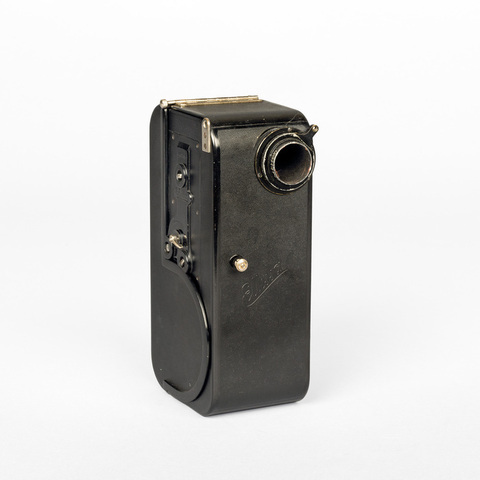
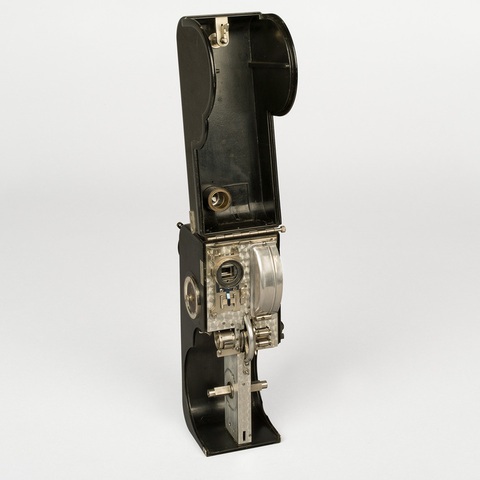
N° Inventaire : AP-19-3370
Collection : La Cinémathèque française
Catégorie d'appareil : Prise de vues cinématographiques
Nom du modèle : Ellessa
Numéro de fabrication : n° 11 218
Lieu de fabrication : Stuttgart, Allemagne
Année de fabrication : 1929
Brevet : Leopold Schabet, USP n° 1 888 574, application filed June 5, 1929, and in Germany July 7, 1928, patented Nov. 22, 1932, "Two-... +
Copyright photo : Dabrowski Stéphane
Fiche détaillée
Type de l'appareil
entraînement du film 16 mm par deux griffes ; deux débiteurs dentés ; emplacement intérieur pour deux bobines co-axiales pouvant contenir 30 m de film ; moteur à ressort ; compteur de mètres ; viseur sur film ; deux axes d'entraînement pour manivelle (absente)
Auteurs
Schabet Léopold
Stuttgart
Fabricants
Ellessa Kino Apparatebau MBH
Stuttgart
Utilisateurs
Schabet Léopold
Stuttgart
Distributeurs
Ellessa Kino Apparatebau MBH
Stuttgart
Sujet du modèle
Informations non disponibles
Objectif
Ruo Optik GmbH 18 943 Kino 1 : 2 F: 3,5 cm
Taille de l'objet
Ouvert :
Informations non disponibles
Fermé :
Longueur : 15.5 cm
Largeur : 9 cm
Hauteur : 23.5 cm
Diamètre :
Informations non disponibles
Taille de la boîte de transport
Longueur : 15.5 cm
Largeur : 9 cm
Hauteur : 46 cm
Remarques
Marque : "Ellessa Patente in allen Ländern Made in Germany".
Le système de présentation et d'ouverture de la caméra a été brevetée en 1928 en Allemagne par Leopold Schabet et en 1929 aux Etats-Unis : "I claim : in a cinematographic camera and projector having a box formed with a housing adapted to receive two cooperatively engaged rolls of film and having in each of its side walls a recess serving as a film magazine, the combination comprising a substantially plane partition, provided with clearances, each of which communicates with one of aforesaid magazines, arranged upon and within the edges of aforesaid box, and of a substantially pan-shaped cover, hingedly connected to the lower front edge of aforesaid box and having on its side walls extensions shaped so as to cover aforesaid recesses, to close the camera" (Leopold Schabet, USP n° 1 888 574, application filed June 5, 1929, and in Germany July 7, 1928, patented Nov. 22, 1932, "Two-part case for cinematographs").
Bibliographie
Filmtechnik, 16 mars 1929.